

In the realm of professional audio recording, large-diaphragm condenser microphones (LDC) have long occupied the apex of technological discourse. This category not only serves as a physical hallmark of professional studios but also constitutes an ecosystem sustained by brand heritage, technical patents, and industry reputation. Traditional brands, particularly those from Germany and the United States, have established deep-rooted user recognition and technical barriers through decades of accumulated acoustic engineering expertise and signature tonal characteristics.
Simultaneously, the global audio industry’s specialized division of labor and diffusion of manufacturing technologies are reshaping market dynamics. Against this backdrop, Alctron emerges as a player attempting to redefine value standards for entry-level professional microphones. By implementing systematic cost control and precise market positioning, the company strives to maintain foundational professional performance while offering accessible pricing. Such product innovation—stemming from industrial upgrades—transcends mere price competition; it involves a holistic overhaul encompassing component selection, acoustic tuning, production processes, and quality management systems. The Alctron CX5 stands as a quintessential product born from these transformative shifts.
This review aims to objectively evaluate whether this budget-friendly LDC microphone delivers genuine, reliable value for creators with limited financial resources, analyzed through three dimensions: its technical essence, practical performance, and market positioning.
(1)(1).jpg "CX5上(场景3)(1)(1).jpg")
As one of the representative brands in China’s audio manufacturing sector, Alctron/爱克创 has adopted a product strategy distinctly focused on entry-level and mid-range markets. The positioning of the CX5 is not to rival legendary models like the Neumann U87 or AKG C414, but rather to establish a recording solution within the sub-1,000 RMB price bracket that adheres to fundamental professional standards. Undeniably, this market segment has long been underserved. High-end products remain prohibitively expensive, while numerous "white-label" alternatives—often lacking transparent technical specifications and consistent quality control—pose significant reliability risks.
The CX5 targets a clear user demographic: home-based music producers, podcast creators, voice-over artists, and small-to-medium studios. These users share a common pain point: the need to achieve substantial improvements in sound quality, sensitivity, and detail resolution compared to consumer-grade USB or dynamic microphones, all within an extremely constrained budget. This upgrade addresses essential audio requirements for online content publishing, demo production, or small-scale commercial projects. With its standardized technical specs and rigorous quality assurance, the CX5 aims to become a "benchmark" product in this niche market.
Design & Build Quality
The CX5 adopts a retro-inspired design typical of large-diaphragm condenser microphones, featuring an all-metal chassis with a striking yet harmonious color scheme of gold and pale yellow. Its construction surpasses expectations for its price range, particularly evident in the precision-engineered dual-layer metal mesh guard protecting the capsule—both robust and meticulously structured. The finish rivals those of higher-priced models, exuding a premium tactile and visual appeal. Functionally, the microphone remains deliberately minimalist, omitting common features like pad switches, reflecting Alctron’s philosophy of prioritizing core performance over superfluous functionalities. Below are two sets of images showcasing the product’s exterior and detailed components.
(1)(1).jpg "CX5下(场景2)(1)(1).jpg")
The internal circuit design serves as a critical window into a microphone’s engineering rigor, technical commitment, and sonic potential—especially for condenser models. The images below illustrate the front and back of the CX5’s circuitry.
.jpg "图-4(1).jpg")
As shown, the microphone employs a dual-layer circuit board architecture, segregating functional zones such as "signal processing," "power supply," and "output." This structured layout enhances noise resistance, preserves signal-to-noise ratio, and ensures frequency response integrity, contributing to long-term reliability. Notably, the impedance conversion and preamplifier circuits incorporate German-made WIMA film capacitors, a deliberate choice to pursue extreme performance. These components leverage their inherent physical properties to guarantee pristine signal purity at the initial stage of transduction, laying a robust foundation for subsequent processing and high-fidelity recording. The output section adopts a transformer-less configuration, utilizing Japanese-made Rubycon electrolytic capacitors for coupling and DC blocking
The included accessories are streamlined but purposeful: an all-metal shock mount and windscreen. Crucially, these components are standard with the product, offering superior quality and performance compared to third-party alternatives. For users seeking optimal recording results, prioritizing these official accessories is advisable. Remarkably, the accessories match the microphone’s build quality, materials, and finish, reflecting Alctron’s philosophy of treating every element—whether core hardware or peripherals—as part of a cohesive, uncompromised system. Below are two image sets showcasing the shock mount and windscreen’s design and details.
.jpg "图-5(1).jpg")
.jpg "图-6(1).jpg")
CX5 Microphone, Shock Mount, Windscreen, Wooden Storage Box, Portable Leather Bag, User Manual.
.jpg "图-7(1).jpg")
Core Technical Specifications & Practical Implications
The table below outlines the CX5’s technical specifications. I will analyze their real-world impact to contextualize the essence of these parameters.
Polar Pattern | Cardioid |
Capsule | 34mm Gold-Spattered Large Diaphragm |
Frequency Range | 20Hz–20kHz |
Sensitivity | -38dB±3dB (0dB=1V/Pa) |
Output Impedance | 100Ω |
Equivalent Noise Level | 16dB-A |
Max SPL | 137dB (@1kHz, 1% THD) |
Connector | 3-Pin XLR |
Power Requirement | 48V Phantom Power |
The CX5 features a 34mm gold-spattered large diaphragm paired with a cardioid polar pattern (see diagram below). This combination forms the physical basis for its sonic signature. Large diaphragms typically deliver broader frequency response and richer low-end reproduction, while cardioid directionality effectively rejects ambient noise from the sides and rear, making it ideal for solo recording in non-ideal acoustic environments.
.jpg "图-8(1).jpg")
As illustrated, sensitivity peaks at 0° (front-axis), ensuring optimal sound capture. Side rejection (90°/270°) is approximately -6dB, necessitating positioning within 0°–60° of the sound source to avoid tonal inconsistencies. Rear rejection (180°) exceeds -20dB, making it adept for scenarios requiring isolation from background noise, such as studio vocals/instruments, stage performances, podcasts, or interviews.
The 20Hz–20kHz range encompasses the entire audible spectrum. Below is the frequency response curve.
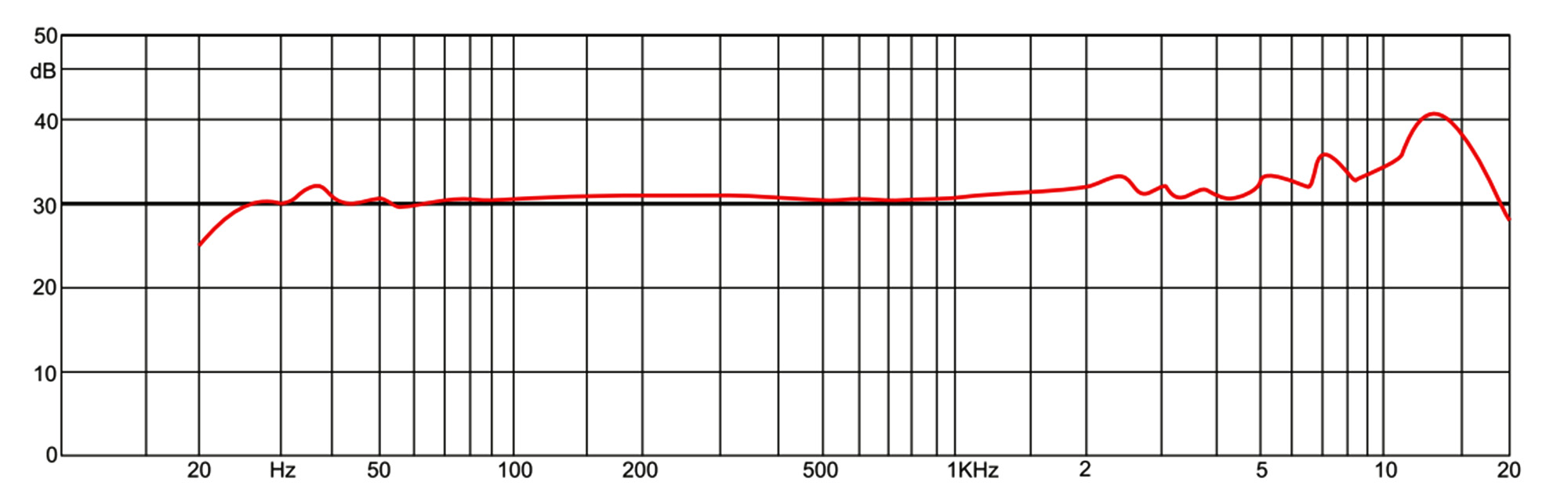
The low-end exhibits a +3dB boost from 30Hz to 50Hz, enhancing warmth and fullness. However, proximity effect may cause bass overemphasis at close range. The midrange (200Hz–4kHz) remains flat within ±3dB, ensuring natural reproduction of vocals and instruments. A subtle lift in the 80–400Hz range adds "body", while a +3dB bump at 2–5kHz improves clarity and presence, aiding speech intelligibility without harsh sibilance. Highs rise gradually after 8kHz, peaking at +7dB near 18kHz for airiness, followed by a smooth roll-off to tame extreme frequencies. Based on listening tests (detailed later) and comparisons with peer products, this tuning prioritizes balanced practicality over exaggerated character.
Sensitivity (-38dB ±3dB):
High sensitivity ensures robust output levels even with modest preamp gain, reducing demands on entry-level audio interfaces. However, it also amplifies ambient noise (room reverb, HVAC systems), necessitating quieter recording environments.
Output Impedance (100Ω):
This value sits optimally within the professional standard range (50Ω–200Ω). It balances noise rejection, load-driving capability, and compatibility with virtually all pro audio gear (interfaces, mixers, preamps featuring >1,500Ω input impedance per impedance-matching principles).
Equivalent Noise Level (16dB-A):
An exceptional figure for a budget LDC microphone, meeting professional SNR requirements. The ultra-low self-noise preserves dynamic headroom and avoids audible interference, rivaling costlier models. This shatters the "entry-level = noisy" stereotype, elevating core performance.
Maximum SPL (137dB @ 1kHz, 1% THD):
Class-leading headroom accommodates aggressive vocals, acoustic instruments, and high-SPL sources. Practical for studio/stage applications requiring proximity to loud sound sources.
Subjective Listening & Multi-Scenario Application Analysis
Vocal Recording (Pop Male/Female):
The CX5 delivers a neutral-warm foundational timbre with subtle sweetening. Its robust midrange provides excellent vocal presence, avoiding the "thin" or "hollow" pitfalls of budget mics. High frequencies extend naturally without forced airiness or harsh peaks, forgiving untrained voices by minimizing sibilance. Low-end response remains controlled, avoiding artificial boominess. The result is a clean, neutral dry signal that serves as an ideal starting point for post-production.
Instrument Recording:
When positioned toward electric guitar cabs, the CX5 captures nuanced details of both amplifier textures and string dynamics. Tonal reproduction stays authentic, with clear yet restrained high-frequency harmonics and well-defined bass extension. Rhythmic passages retain punch, while arpeggios sound lush and articulate.
Podcast/Narration:
Here, the CX5’s cardioid pattern shines, rejecting ambient noise effectively. Its focused midrange ensures exceptional speech clarity and listener engagement. Compared to mainstream USB/dynamic mics, it elevates content quality to a professional tier, instantly enhancing perceived credibility.
Market Competitor Comparison
vs. Audio-Technica AT2020:
A longstanding benchmark in its price class, the AT2020 offers brighter, more direct highs. The CX5 counters with warmer, smoother character. While AT2020 leads in brand recognition, the CX5 competes fiercely on sonic value—choice depends on user preference for analytical vs. forgiving signatures.
vs. sE Electronics sE2200:
Both are cardioid LDCs, but diverge in philosophy. The sE2200 emphasizes modern transparency and detail via switchable high-pass/pad. The CX5 prioritizes warm, full low-mids and tamed highs, excelling with imperfect sources/environments. It appeals to users seeking fatigue-free listening over clinical precision.
vs. Peers in Price Range:
The CX5’s edge lies in balanced technical execution. Unlike rivals chasing single-parameter excellence or cost-cutting, it adopts a prudent approach: ensuring seamless frequency coherence, cardioid stability, and low self-noise before optimizing real-world reliability. This “no weak links” strategy minimizes performance unpredictability—a critical advantage for budget-conscious creators.
Conclusion
Priced at ¥1,680 RMB, the Alctron/ CX5 defines itself through purposeful design. It democratizes access to large-diaphragm condenser technology, offering a gateway to professional results without premium costs. Its triumph isn’t dethroning industry titans but establishing a dependable baseline for creative workflows. For its target audience, the CX5 embodies rational spending—maximizing utility within constraints. It may not mark the pinnacle of recording journeys, but it undoubtedly anchors them with unwavering reliability.
Core Advantages:
l Exceptional Price-to-Performance Ratio: Delivers core functionality and certified sound quality of a large-diaphragm condenser microphone at an ultra-low cost.
l Stable & Reliable Sound: Neutral tonal character with no artificial coloration, providing an ideal foundation for post-processing—particularly suitable for beginners.
l High Sensitivity: Low demand on preamp circuitry, reducing system-building complexity.
l Minimalist & Practical Design: Cardioid polar pattern caters to the most fundamental yet widely used recording needs.
l Retro Industrial Aesthetic: Premium tactile feel combined with vintage-inspired pale yellow and gold color scheme, exuding timeless elegance.
Limitations:
l Demanding Acoustic Environment: High sensitivity acts as a double-edged sword, amplifying flaws in suboptimal acoustic conditions.
Target Audience & Purchasing Recommendations:
l Budget-Conscious Beginners: Ideal for upgrading from computer/built-in or low-end dynamic mics with minimal investment.
l Content Creators (Podcasters, YouTubers, Short-Form Narrators): Prioritizes professional voice clarity while adhering to strict budget discipline.
l Small Studios Needing Backup/Multi-Mic Setups: Cost-effective, consistent units for choirs, interviews, or multi-instrument sessions.
l Recording Novices: Offers hands-on experience with pro LDC workflows without excessive upfront trial-and-error costs.
Ningbo Alctron Electronics Technology Co., Ltd
Add: No.76, San Cheng Road, Xiu Feng Industry Area,Gaoqiao Town, Ningbo China.
E-mail: sales@alctron-audio.com
Tel: +86 574 88011699
Fax:+86 574 87157176
Post code: 315191
 简体中文
简体中文 ENGLISH


